Shaba Used Auto Parts Market
The ShepherdShaba Used Auto Parts Market is introduced as a weapons hub beneath the appearance of an ordinary auto-parts business. Haydar directs Lawson there to obtain guns, drawing him into a network where arms commerce, political cover, and the danger of being recognized converge. The market’s importance lies not only in what it can supply, but in the history and compromised local relationships that make using it risky.
Setting and History
Haydar identifies the market as Lawson’s first stop, about a mile away. Its name suggests a straightforward trade in used cars and automotive supplies, but Haydar warns that weapons are its real business. The distinction between the public-facing name and the activity behind it is central to the location: the market’s apparent normality provides cover for a much less ordinary trade.
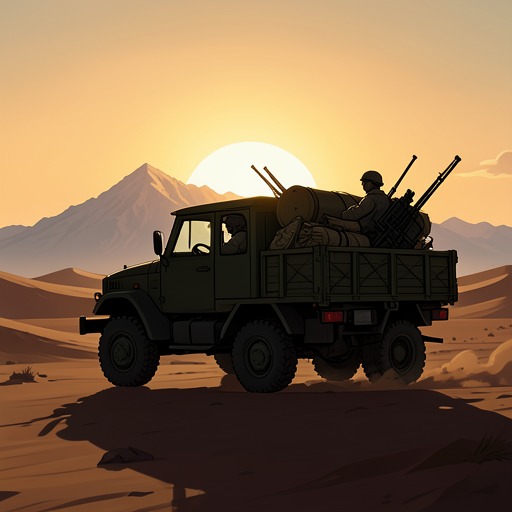
That trade has a history reaching back to the period when the Soviet presence was just across the border. Haydar describes the people there as established arms suppliers from that time, a place to go for firearms of many kinds. He recalls hearing from a friend that they once produced a fairly reliable Stinger imitation. The detail is hearsay, not a demonstrated capability in the present, but it conveys the market’s reputation for adapting weapons technology as well as selling arms.
Arms, Land, and Intelligence
The market’s business is tied to a broader system of property and political protection. Haydar explains that arms dealing paid well enough for those involved to buy up land, giving the enterprise a convenient cover. He also says Pakistani intelligence knows about the operation, while characterizing the relationship as corrupt. The market is therefore not presented as a hidden trade operating wholly outside official awareness; its survival is bound up with compromised connections to the institutions that might otherwise be expected to oppose it.
This account makes the location’s commercial facade part of its political function. The auto-parts identity and the acquired land offer a respectable appearance, while the weapons trade and intelligence relationship complicate any clear division between legitimate business and covert activity. The novel supplies Haydar’s assessment rather than a fuller institutional explanation, but his warning gives Lawson a reason to treat the place as a security problem as well as a source of equipment.
Lawson’s Visit and the Cost of Exposure
Haydar sends Lawson into the market alone. Although Haydar says it is where he does his own shopping, he cannot risk being exposed by this operation: he must remain in the country afterward and fears that angry fundamentalists could come after him. Lawson, by contrast, expects to go home when the job is finished. The difference in their positions turns a practical errand into a division of risk. Haydar can guide the operation, but Lawson must be the visible visitor.
After leaving Shaba, Lawson crosses the street and makes a quick surveillance-detection loop. He sees an elderly man pushing a fruit cart, but the ordinary activity does not prove that the area is safe; Lawson recognizes that a professional team could be positioned elsewhere without his noticing. He nevertheless feels clear for the moment. The qualification matters: the market episode leaves him with provisional confidence, not certainty that he has escaped observation.
The visit also puts Lawson’s cover under pressure. Haydar later asks how Mubar reacted, and Lawson reports that Mubar seemed a businessman but did not believe his claim to be Canadian. Haydar suggests that German would have sounded more plausible, especially because Lawson speaks the language, and says that claiming to be Canadian in that area amounts to presenting oneself as American. The market’s danger thus extends beyond the weapons available there: a suspicious buyer can test the identities on which an undercover operation depends.
Place in the Cross-Border Operation
Shaba sits within the Peshawar portion of a mission that soon moves toward Afghanistan. After the market visit, Haydar presses to move quickly because word has already begun to circulate and he wants to see what that attention will reveal. Their drive takes them away from Peshawar toward tribal-authority areas and, later, a point five miles from the Afghan border. Haydar directs Lawson from there onto a narrow animal track that he has scouted, while the conspicuous vehicle stays behind.
The sequence gives the market a role as an early logistical threshold rather than the destination of the mission. Lawson needs guns before he can proceed; Shaba supplies access to the weapons trade, but obtaining them does not remove the danger of surveillance or recognition. From the market’s commercial cover, the operation moves into increasingly exposed border terrain. Its significance is precisely in that transition: the place helps equip the mission while revealing that every act of preparation can also generate attention, suspicion, and risk.